
Module 9: What Words Cost
The Linguist — Discover the hidden cost of language
Duration: 60 min | Difficulty: Intermediate | Prerequisite: Module 1 (What Is a Token?), Module 4 (What Does the Model See?)
The Aha Moment
The same sentence costs 3x more tokens in Arabic than English — not because it's longer, but because the tokenizer was trained mostly on English. This invisible tax affects context length, speed, and quality for billions of non-English speakers.
Language models do not process text directly. They first pass it through a tokenizer — a compression algorithm that breaks text into subword pieces. The most common algorithm, Byte Pair Encoding (BPE), learns its merge rules from whatever training corpus it was given. When that corpus is 80-90% English, the tokenizer becomes extremely efficient at compressing English words into compact tokens. Common English words like "the," "hello," or "information" each become a single token. But the same tokenizer, faced with Arabic, Hindi, or Chinese text, has never learned the merge rules for those scripts. It falls back to byte-level or character-level encoding, producing three to five times as many tokens for the same semantic content.
This is not a deliberate design choice. No one decided that Arabic should cost more. It is a statistical consequence of training data imbalance — and it has real consequences. More tokens means less room in the context window, slower generation, higher API costs, and in many cases lower output quality. The tokenizer bias is invisible to users: the prompt looks the same length on screen regardless of language. But inside the model, the computational burden is wildly different. LLMxRay makes this invisible tax visible.
Conceptual Background
What is tokenization bias?
BPE tokenizers build their vocabulary by iteratively merging the most frequent character pairs in the training data. After thousands of merge operations, common English sequences like "tion," "ing," and "the" become single tokens. The tokenizer has effectively learned to compress English efficiently because it saw so much of it during training.
Languages that were underrepresented in the training corpus never get this compression benefit. Arabic characters, Devanagari script, CJK ideographs — these get merged less frequently or not at all. When the tokenizer encounters them at inference time, it falls back to encoding them as raw UTF-8 bytes. A single Arabic character that represents a complete morpheme might become three or four tokens. A single Chinese character that carries as much meaning as an English word might become two or three tokens.
This is not a bug in the algorithm. BPE is doing exactly what it was designed to do: compress frequent patterns. The bias comes from the data, not the algorithm. But the effect is the same: a structural disadvantage for every language that was not well-represented in the tokenizer's training set.

The token tax
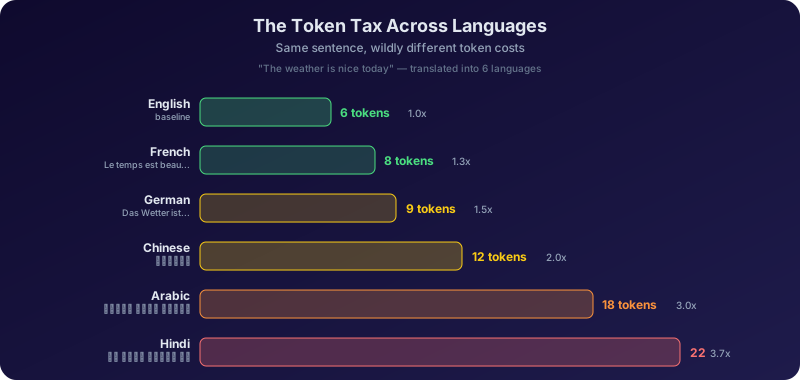
Consider a concrete example. The English greeting "Hello" is a single token in most modern tokenizers. The Arabic equivalent, "مرحبا", is typically five tokens — each character encoded separately because the tokenizer never learned to merge Arabic character sequences. The English sentence "The weather is nice today" might cost six tokens. The same meaning in Arabic, "الطقس جميل اليوم", might cost eighteen tokens.
This is the "token tax" — a hidden surcharge that non-English speakers pay for every interaction with a language model. The tax compounds across every dimension of model usage:
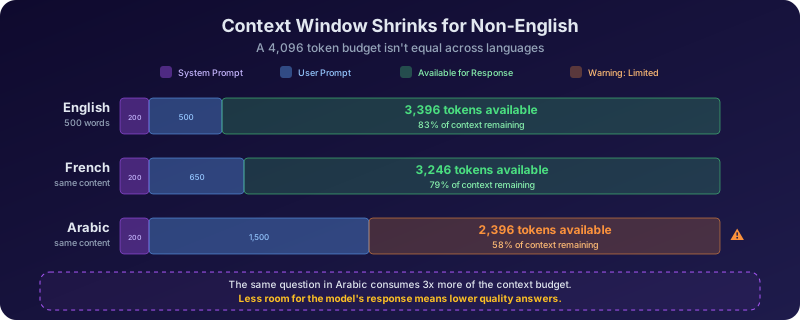
- Context window: A 4,096-token window holds roughly 3,000 words of English but only 1,000 words of Arabic content
- Latency: More tokens means more forward passes through the attention mechanism, increasing time to first token and reducing tokens per second
- API cost: Commercial APIs charge per token — Arabic users pay three times as much for the same conversation
- Quality: Models that have seen less training data in a language produce lower quality output in that language, and the inflated token count means less room for the model's response
Why it matters
The token tax is not an abstract fairness concern. It has concrete engineering consequences that affect billions of people.
A developer building a chatbot for Arabic speakers faces a fundamentally different constraint landscape than one building for English speakers. The same 4,096-token context window that comfortably holds a system prompt, conversation history, and response in English becomes severely cramped in Arabic. The system prompt alone might consume a third of the budget. Add a few turns of conversation history and there is barely room for the model to generate a useful response.
The problem compounds with the data scarcity issue. Languages that are underrepresented in the tokenizer's training data are usually also underrepresented in the model's pretraining data. So not only does Arabic cost more tokens — the model has also seen less Arabic text during training, making it less capable in Arabic. The token tax and the quality gap reinforce each other: worse tokenization means less effective use of the context window, which means lower quality output, which means the language appears even harder for the model.
For retrieval-augmented generation (RAG) systems, the impact is even more severe. If your retrieved documents are in a high-token-cost language, fewer chunks fit into the context window, reducing the amount of relevant information the model can see before generating its response.
Can it be fixed?
Several approaches attempt to reduce tokenization bias:
Multilingual tokenizers. SentencePiece and Unigram models can be trained on balanced multilingual corpora. Models like mT5 and BLOOM used tokenizers trained on data from 100+ languages, producing more equitable token counts across scripts. The trade-off: a larger vocabulary is needed to efficiently represent many languages, which means a larger embedding matrix, which means more GPU memory.
Language-specific models. AceGPT for Arabic, Yi for Chinese, and Sarvam for Hindi use tokenizers trained predominantly on their target language. These models achieve near-English tokenization efficiency for their language — but only for that language. You trade multilingual capability for single-language efficiency.
Balanced training data. The most direct fix is to train the tokenizer on a corpus that represents all target languages proportionally. Projects like BigScience's ROOTS dataset and Meta's "No Language Left Behind" initiative work toward this goal. But proportional representation is itself a question — should every language get equal weight, or should weight reflect speaker population, internet presence, or some other metric?
Vocabulary expansion. Some researchers propose adding language-specific tokens to an existing vocabulary without retraining from scratch. This can improve efficiency for underrepresented languages, but the new tokens start with random embeddings that must be fine-tuned, and the expanded vocabulary increases model size.
No perfect solution exists yet. Every approach involves trade-offs between vocabulary size, model size, training cost, and multilingual fairness. But awareness is the first step. If you can measure the bias — and LLMxRay lets you measure it directly — you can make informed decisions about model selection, context budgeting, and prompt design for your target languages.
Hands-On Exercises
Exercise 1: The Token Counter
What to do:
- Open LLMxRay's Compare page
- Select the Language Compare preset
- Type the following prompt:
The weather is nice today - The system will detect English. When the conflict popup appears, select French and Arabic as translation targets
- Run the comparison across all three languages using the same model
- Record the prompt token count for each language from the ComparisonMetricsBar
What you'll discover:
The same six-word sentence produces wildly different token counts depending on the language. Calculate the ratio: how many times more tokens does Arabic require compared to English? How about French? French, as a Latin-script language, should fall somewhere between English and Arabic — it shares much of the same character set as English but uses accented characters and longer words.
Why Language Compare?
The Language Compare preset automatically handles translation and runs the same model on each language variant under identical conditions. This removes translation quality as a variable — the meaning is held constant while the language changes.
Exercise 2: The Context Shrink
What to do:
- With context set to 4,096 tokens, prepare a paragraph of approximately 500 words in English
- Paste it into the Compare page with the Language Compare preset selected
- After translation and execution, check the prompt token count for each language (English, French, Arabic)
- For each language, calculate:
- What percentage of the 4,096-token budget does the prompt consume?
- How many tokens remain for the model's response?
- If the system prompt uses 200 tokens, what is the effective remaining context?
What you'll discover:
A 500-word English paragraph might use around 600 tokens (about 15% of the budget). The same content in Arabic could use 1,800 tokens (44% of the budget). After accounting for the system prompt, the Arabic user has roughly half the response space that the English user enjoys. This is the context shrink in action — the same information, the same model, the same context window, but a dramatically different user experience.
Exercise 3: The Speed Test
What to do:
- Choose a prompt of moderate length (2-3 sentences)
- Run it through Compare with the Language Compare preset in three languages: English, French, and Arabic
- Use the same model for all three
- From the metrics panel, record for each language:
- TTFT (Time to First Token)
- Tokens per second (generation speed)
- Total generation time
What you'll discover:
More tokens means more computation. The attention mechanism scales quadratically with sequence length in standard transformers, so a prompt that is 3x longer in tokens does not just take 3x longer — it can take significantly more. Compare the TTFT across languages: is the model slower to start generating when the prompt contains more tokens? Compare tokens per second: even though the Arabic response generates more tokens, are those tokens produced at the same rate? The speed difference is another dimension of the token tax that affects real-time applications like chatbots and voice assistants.
Exercise 4: The Embedding Equality Check
What to do:
- Go to the Embeddings page
- Open the Similarity Calculator
- In Text A, enter:
I love this movie - In Text B, enter:
أحب هذا الفيلم - Generate embeddings and check the cosine similarity score
- Try additional pairs:
The cat sat on the mat/جلست القطة على الحصيرةMachine learning is transforming healthcare/التعلم الآلي يحول الرعاية الصحية
What you'll discover:
Despite the wildly different tokenization paths — English compressed into compact tokens, Arabic fragmented into byte-level pieces — the embedding model maps both sentences to nearby points in vector space. The cosine similarity should be high (0.7+), indicating that the model has learned to extract meaning independently of surface-level tokenization. This reveals something profound: tokenization is a lossy compression step, but the model's deeper layers can sometimes recover the lost efficiency. The meaning survives the tokenization bottleneck — but the computational cost does not.
Embedding model required
You need an embedding model pulled in Ollama (e.g., nomic-embed-text or bge-m3). The multilingual model bge-m3 works best for cross-language comparisons.
Key Takeaways
- Tokenizers have a language bias inherited from training data distribution. BPE merge rules reflect corpus frequency — English-dominated training data produces English-optimized tokenizers. This is a statistical consequence, not a deliberate design choice, but the effect is structural.
- Non-English languages pay a "token tax" — same meaning, more tokens, less context. Arabic, Hindi, and Chinese text can cost 3-5x more tokens than English for the same semantic content. This tax is invisible to users but real in its consequences.
- The token tax affects context window, speed, generation quality, and API cost. A 4,096-token context window is effectively a 1,300-token window for Arabic users. More tokens means slower inference. Commercial APIs charge per token regardless of language.
- LLMxRay's Language Compare preset makes this invisible tax visible. By running the same meaning through different languages under controlled conditions, you can directly measure the tokenization penalty and its downstream effects on latency and context consumption.
- Multilingual tokenizers improve but do not eliminate the bias — awareness matters. SentencePiece, balanced training data, and language-specific models all help. But no perfect solution exists yet. Understanding the bias is the prerequisite for mitigating it in your own systems.
Discussion Questions
- If you were building a chatbot for Arabic speakers, how would the token tax affect your architecture decisions (model choice, context size, prompt engineering)?
- Should AI companies charge per-token equally across languages, knowing that some languages inherently cost more tokens? Is this fair?
- How does tokenization bias relate to the broader issue of English dominance in AI research and deployment?
- Could a "perfect" multilingual tokenizer exist? What trade-offs would it require (vocabulary size, model size, training cost)?
- How might tokenization bias affect hallucination rates in underrepresented languages? (Connect to Module 3.)
Further Reading
Academic Papers
| Paper | Authors | Year | Link |
|---|---|---|---|
| Language Model Tokenizers Introduce Unfairness Between Languages | Petrov et al. | 2023 | arXiv:2305.15425 |
| All Languages Are Not Created (Tokenized) Equal | Ahia et al. | 2023 | arXiv:2305.13707 |
| Tokenizer Choice For LLM Training | Rust et al. | 2021 | arXiv:2012.15613 |
| No Language Left Behind | Costa-jussa et al. (Meta) | 2022 | arXiv:2207.04672 |
Tutorials
| Resource | Author | Link |
|---|---|---|
| The Tokenizer Playground | HuggingFace | huggingface.co/tokenizers |
| Understanding BPE Tokenization | Lilian Weng | lilianweng.github.io |
Assessment
Option A — Individual data report (1 page): Run the Language Compare preset on 4 or more languages using the same model and the same prompt. Document the token ratios between each language and English, the TTFT differences, and the effective context loss for each language. Calculate what percentage of a 4,096-token budget each language consumes for the same content. Include screenshots from LLMxRay showing the ComparisonMetricsBar and any diff views.
Option B — Pairs presentation (slide deck, 8-10 slides): Compare 2 different models' tokenization efficiency across 3 languages. For each model-language combination, record prompt token count, TTFT, and tokens per second. Which model has a smaller language gap? Is the model with the better multilingual tokenizer also better at generating responses in non-English languages? Present your findings with data tables and LLMxRay screenshots.
Option C — Group policy paper (500 words): Design a "fair pricing" model for a multilingual AI API service. Should pricing account for tokenization bias? If an Arabic query costs 3x more tokens than the same query in English, should the Arabic user pay 3x more, the same amount, or something in between? Justify your pricing model with data from your Language Compare experiments. Consider the perspectives of the API provider (compute costs are real), the end user (fairness matters), and society (language equity in AI access).
Module 9 of 9 in the LLMxRay Educators Kit ← Module 8: The Full Picture | Back to Curriculum